Explore the Moon: Overview
Background
The Moon is that world next door, a grey sphere that catches our eye but isn’t nearly as exciting as some of the other worlds out there, like ruddy Mars or brightly striped Jupiter or lava spewing Io. While the Moon may not be the “It” world everyone has fantasies of sending a spacecraft to, it is one we actually have the potential to visit, and have visited in the past. And we’re not just talking about visiting with robotic spacecraft, we’re looking forward to a not-too-distant day when humans can once again look back at Earth from the surface of the Moon.
With this community science project, we will explore Lunar Impact Melt flows. When large enough asteroids hit the Moon, the kinetic energy from the impact will carve out a crater and, in many cases, melt enough rock to send white hot, gooey melt (it’s what we’d call “lava,” except that it didn’t erupt from underground) sloshing around the new crater and surrounding regions. An example of this kind of lunar melt flow appears below. This image comes from near a small crater near Tycho crater. It’s nicknamed Little Lowell Crater, and it’s one of the regions you’ll be mapping!
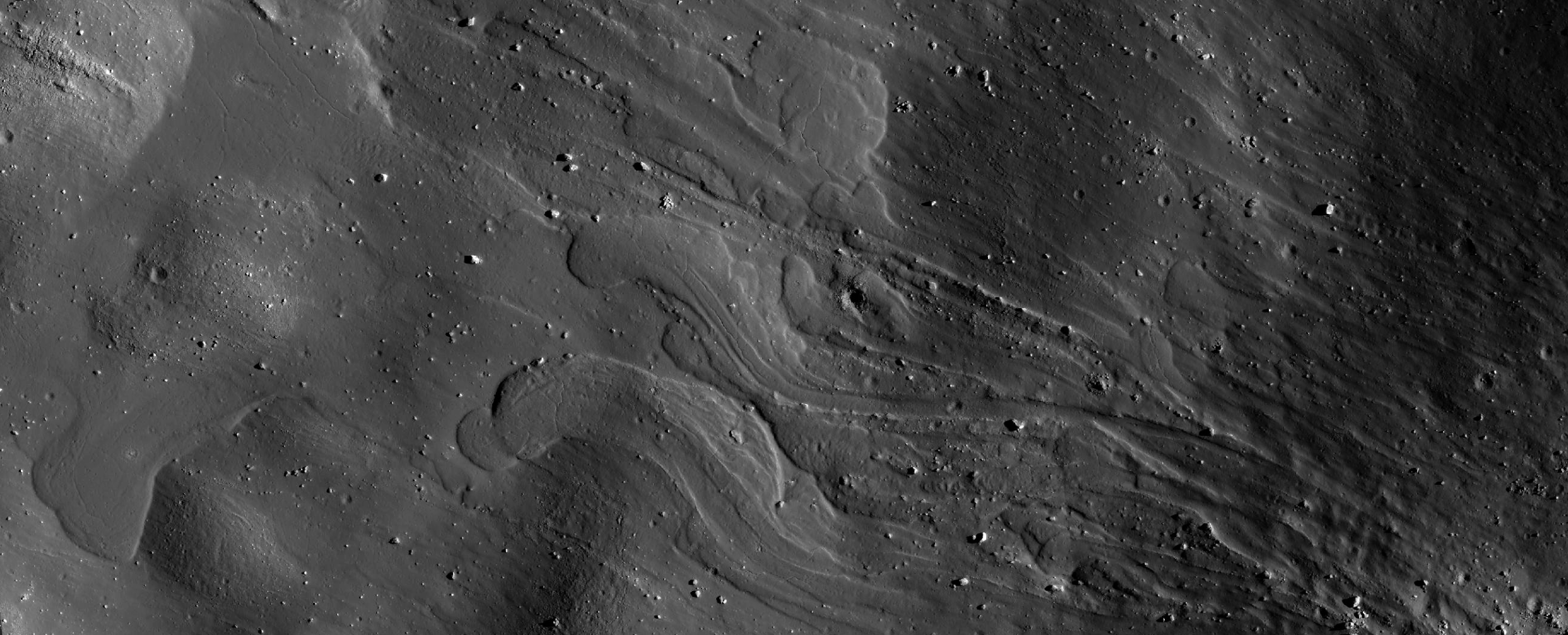
This image shows a very flow-y-looking deposit of once-molten impact melt that flowed out of a crater we’ve nicknamed Little Lowell. This is one of the best examples of very young (less than a few hundred million years old and probably a few 10s of millions of years old) impact melt flows on the Moon. Image Credit: NASA/ASU/IM
Lunar Fast Facts
Related Projects
- Lunar Features: Map craters, boulders, and rocks
- Lunar Flows: Trace flows and channels, cracks, & ridges
Data Source
- Mission: Lunar Reconnaissance Orbiter
- Camera: Narrow Angle Camera
- Resolution: ~0.5m / 1.5 ft per pixel
- Image Credit: NASA/Arizona State University/Intuitive Machines (link)
Project images are 450 pixels across. This makes them a little more than twice as long as a regulation soccer field.
Related Pages
The Power of Liquid Rock
Flowing liquids — whether that liquid is water, lava, or impact melt — can carry heavy objects, including chunks of the Moon’s surface! If you find a really huge boulder sitting at the end of a lava or impact melt deposit, that means that the flow was at least strong enough to carry something that massive. Scientists who use computer models to simulate the flow of molten rock use the information on boulder size to estimate the strength of the flow. And, just like how more ice cubes do a better job of cooling your drink, the more solid rocks hanging around in molten rock — and the closer together they are — can affect how fast or slow the melt cools into a solid. But there are a lot of rocks. A lot. (You’re going to see this for yourself if you help with this project!) That’s where we need your help to mark the locations of rocks and to tell us the longest dimension on each boulder. When you click on individual rocks, you’re telling future computer code, “Hey! You need to account for all these rocks right here and how they affected the flow of molten rock!”
Craters that formed before and after the lunar melt flowed through the region also tell us about the Moon’s history. How big are our craters? Where are they? We need YOU to tell us, because these holes-in-the-ground can affect the path taken by the impact melt when it was molten. And, craters on top of impact melt deposits can tell us how deep the melt is.
Why we need you
In this project, we’re going to ask you to map a variety of lunar features. Some of these appear all over the Moon, like craters, boulders, and rocks. Others are specific to regions with lunar melt, such as flows, channels, cracks, and ridges. These are all visually distinct geologic features that we can teach you to recognize.
You might think this is something some computer AI should be able to do, but the truth is, the technology just isn’t there yet. The material on the Moon’s surface comes in different colors and textures (and shadows are always changing). These variations can confuse an AI that can’t differentiate between a level spiral of different-colored materials and a topographic feature that shapes the Moon’s surface.
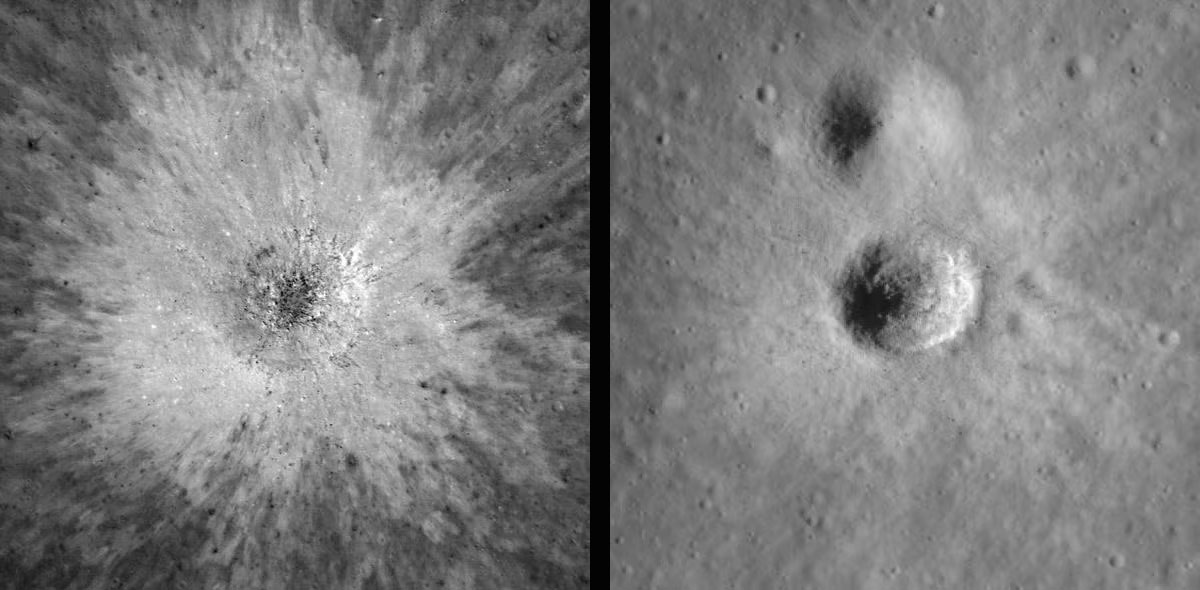
The Reiner Gamma feature on the Moon is likely due to a local magnetic field effecting how the Moon’s surface is weathered over time. This region of the Moon is smooth, but can confuse AI into thinking there is some kind of topographic feature. Credit: NASA/LRO WAC team

The Reiner Gamma feature on the Moon is likely due to a local magnetic field effecting how the Moon’s surface is weathered over time. This region of the Moon is smooth, but can confuse AI into thinking there is some kind of topographic feature. Credit: NASA/LRO WAC team