Lunar Data Set
Background
Images shown in the Lunar Melt project come from the Narrow Angle Camera (NAC) which is part of the Lunar Reconnaissance Orbiter (LRO) Camera (which is actually three cameras, 2 Narrow Angle Cameras and 1 Wide Angle Camera). We can’t explain why the LRO Camera (LROC) is actually three cameras, but we can explain just how amazing the NAC data happens to be.
LRO has been orbiting the Moon since 2009. Its current orbit keeps it between 20km (12mi) and 165km (103mi) above the Lunar surface. The mission’s low altitude and high-resolution cameras work together to create images so detailed that a basketball player lying on the surface of the Moon with their arms spread out would appear as a tiny blob. Put into numbers, when LRO is closest to the Moon, each pixel in the best NAC images is about 0.5 m (or about 1.5 feet) across. (When the LRO is higher up, the pixels are more like 2m across, which would make that basketball player just over 1 pixel in size.)
This mission was proposed and led by Mark Robinson (initially at Arizona Stat University and now at Intuitive Machines), and spacecraft development took place at the NASA Goddard Space Flight Center. Today, you can access all the mission’s data and learn about its current activities on the project website. They even have a data exploration tool, QuickMap, that will let you look at different images taken over time. LRO’s data are regularly used to monitor the Moon for impacts, study potential mission landing sites, and check out the health and well-being of spacecraft that have landed (or impacted) on the Moon.
LRO’s original mission only funded / approved for 1 year. The spacecraft, 17 years later, remains healthy and its funding has been regularly renewed, allowing continuing science. The spacecraft is carrying enough fuel to continue operating through 2027, and it is helping to image the way for future lunar exploration mission operations.

Lunar Fast Facts
Related Projects
- Lunar Features: Map craters, boulders, and rocks
- Lunar Flows: Trace flows and channels, cracks, & ridges
Data Source
- Mission: Lunar Reconnaissance Orbiter
- Camera: Narrow Angle Camera
- Resolution: ~0.5m / 1.5 ft per pixel
- Image Credit: NASA/Arizona State University/Intuitive Machines (link)
Project images are 450 pixels across. This makes them a little more than twice as long as a regulation soccer field.
Related Pages
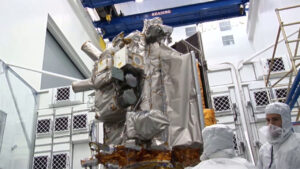
The Lunar Reconnaissance Orbiter was built at Goddard Space Flight Center in Greenbelt, Maryland. It is shown here having its center of gravity determined during spin testing. Credit: NASA/Goddard Space Flight Center
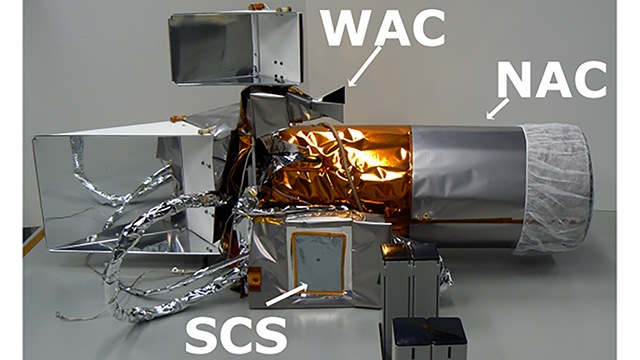
The Lunar Reconnaissance Orbiter consists of 3 parts: a wide-angle camera (WAC), a pair of narrow-angle cameras (NAC), and a sequence and compressor system (SCS) which commands the spacecraft during imaging. Credit: NASA/Intuitive Machines
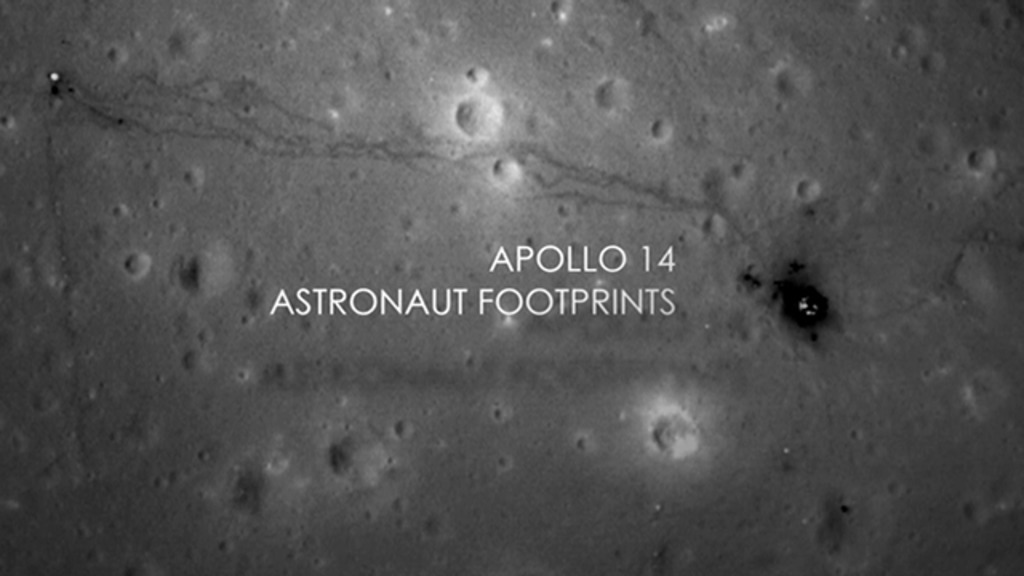
The LROC NAC has a resolution of around 0.5 m per pixel. This makes it possible to resolve the dark paths left as Apollo 14 astronauts disturbed the light regolith on the lunar surface. Credit: NASA/Goddard Space Flight Center
Getting the Images at just the right Angle
The mission orbits in a polar orbit, which is an orbit that passes nearly straight over the north and south poles of the Moon. This orbit allows LRO to image the entire Moon under a variety of conditions, including with the Sun straight over head and at a variety of angles.
In this project, you’ll mostly see images with the sunlight coming in at an angle that creates dramatic shadows. When the Sun is straight overhead on the Moon, it is easy to see how different regions are made of different colored images (left image below), but some craters will completely disappear. When the Sun sinks toward the horizon, shadows cause otherwise invisible craters to pop into view.
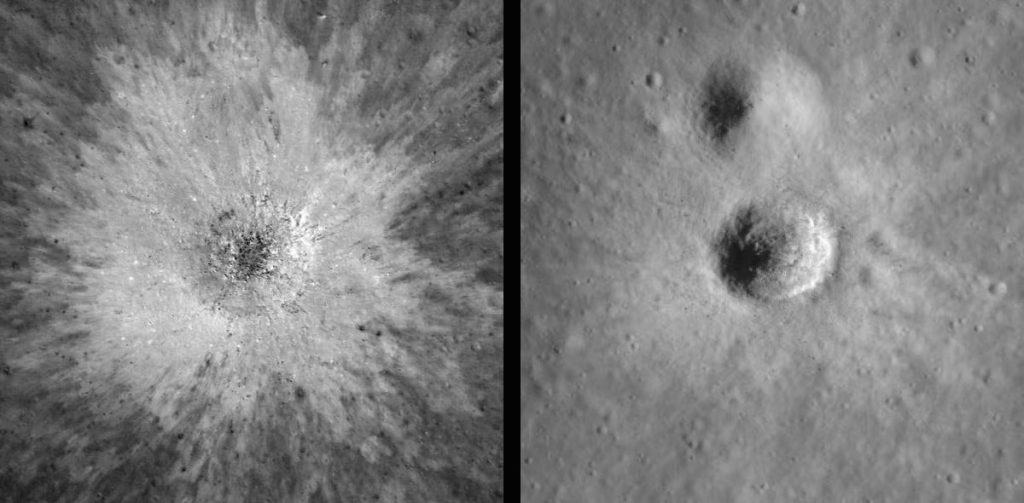 The exact same 660m wide region of the Moon is shown at two different times of the Lunar day. On the left (M108108187L), the Sun is near “noon”, and variations in surface color are easy to see. On the right (M103388681R), the Sun is off to the left, and the shadows make all the craters in the image visible. Note: These images have very different contrasts. Credit: NASA/GSFC/Arizona State University. Learn more
Did you know?
The LRO’s amazing resolution makes it incredably useful for studying both past human exploration of the Moon and current missions. This has allowed it to both do its own form of archeology and to also perform search and rescue when NASA and other space agencies / companies have lost contact with their missions.
How do we know humans have gone to the Moon and new missions have returned to the Moon? LRO can see their impacts on the Lunar surface!
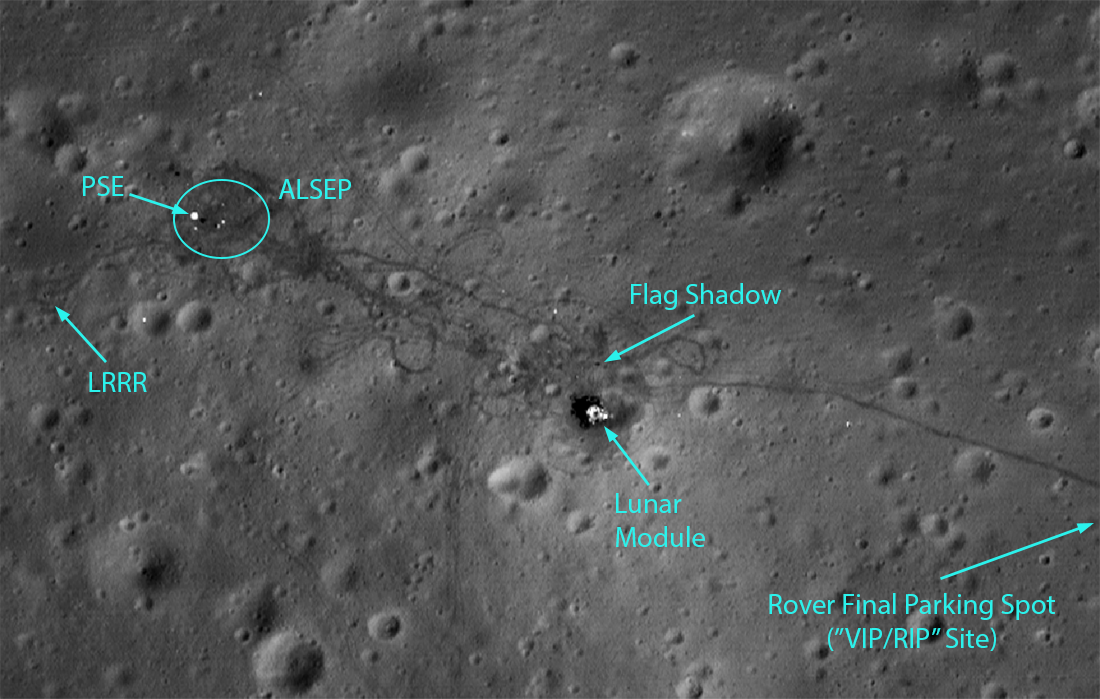
Per the LRO Team, this image, “Highlights of the Apollo 15 landing site, as seen in LROC NAC image M175252641R. This image has a resolution of 27 cm/px, and shows an area of 262 m by 186 m. The Lunar Module is clearly visible, as are many tracks from the Lunar Roving Vehicle (whose final resting place is just east of the edge of this image). The Apollo 15 astronauts left a number of science instruments at the site, including the Passive Seismometer Experiment (PSE), Lunar Ranging Retroreflector (LRRR), and others; these instruments were collectively part of the Apollo Lunar Surface Experiments Package (ALSEP). These landmarks and more are annotated in LROC’s new Apollo 15 spatiotemporal map.”
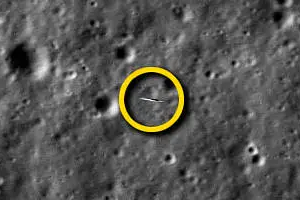
The LADEE orbiter imaged on January 14, 2014. (LROC NAC image M1144387511LR). Learn more here. Credit: NASA / Goddard / Arizona State University.
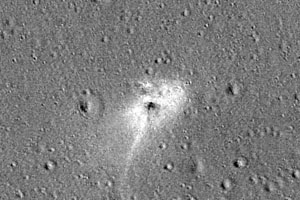
Beresheet lander crashed into the Moon on April 11, 2019 and was imaged on April 22, 2019 by (LROC NAC image M1310536929R). Learn more here. Credit: NASA / Goddard / Arizona State University.